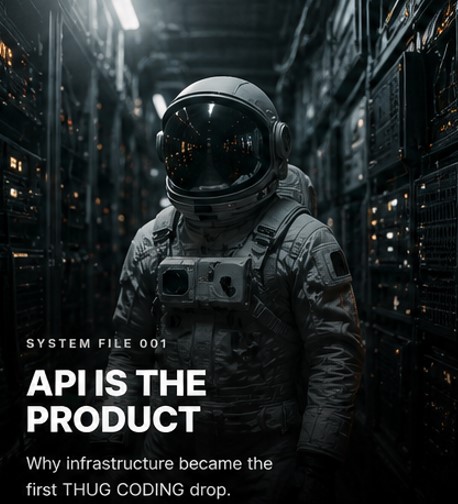
SYSTEM FILE 001
API IS THE PRODUCT
Why infrastructure became the first THUG CODING drop.
Most brands sell products.
THUG CODING is building the system products move through.
The modern storefront is no longer just a store.
It is:
- media platform
- analytics engine
- identity system
- recommendation engine
- infrastructure layer
- cultural operating system
The hoodie is only the visible layer.
Underneath it:
- APIs move inventory
- analytics measure behavior
- systems track movement
- algorithms shape visibility
- dashboards score performance
- infrastructure determines scale
Commerce became programmable.
Most people still think a brand is:
- logo
- product
- checkout
But the modern brand is infrastructure.
Every interaction becomes signal.
Every view.
Every scroll.
Every abandoned cart.
Every search.
Every click.
Every product save.
Every replayed video.
Signal.
The system watches movement.
Not to imitate culture.
To understand it.
The old internet separated:
- media
- products
- software
- commerce
- identity
Now they are collapsing into one system.
The storefront became the interface.
The API became the engine.
The product became data.
The customer became traffic flow.
The brand became a network.
THUG CODING was never designed to be:
- only apparel
- only content
- only software
It was designed as:
- programmable culture
- cinematic commerce
- infrastructure-driven identity
The journal is part of the product.
The video is part of the product.
The dashboard is part of the product.
The analytics are part of the product.
The system itself became the product.
A hoodie can be copied.
Infrastructure is harder to replicate.
Most companies rent platforms.
Few build systems.
The future belongs to:
- brands with infrastructure
- creators with systems
- platforms with audience ownership
- media ecosystems with programmable intelligence
The next generation of companies will not look like stores.
They will look like:
- networks
- operating systems
- cultural engines
- infrastructure layers
THUG CODING exists at the intersection of:
- technology
- systems
- fashion
- media
- infrastructure
- identity
The storefront is only the entry point.
The API is the product.
000000000000000000000000000000000000000000000000000000000000
SYSTEM FILE 001
API IS THE PRODUCT
Why infrastructure became visible.
Most people think clothing brands are built from fabric.
Cotton.
Ink.
Packaging.
Photography.
But modern brands are increasingly built from systems.
The shirt is physical.
The business behind it is infrastructure.
Most customers never see that layer.
They see:
- homepage
- product photos
- checkout button
- shipping notification
But underneath almost every modern brand is a hidden network of software constantly making decisions.
Inventory systems determine availability.
Algorithms determine visibility.
Analytics determine what gets reproduced.
Recommendation engines determine what gets discovered.
Payment systems determine whether the company survives.
Most modern commerce is no longer just retail.
It is programmable infrastructure.
A product can now move through:
- APIs
- automation systems
- analytics dashboards
- recommendation engines
- creator platforms
- fulfillment networks
- audience systems
without the customer ever seeing the machinery underneath it.
That shift changes everything.
Years ago, a storefront was mostly:
- shelves
- products
- transactions
Now a storefront is:
- media platform
- data system
- recommendation engine
- audience network
- analytics layer
- content machine
Commerce and software collapsed into each other.
The same company can now be:
- fashion brand
- media company
- technology platform
- analytics system
- creator network
at the same time.
That is the world THUG CODING was built inside of.
Not just fashion.
Infrastructure.
Most brands today are renting visibility.
Their audience exists on platforms they do not control.
Their traffic depends on algorithms they do not own.
Their growth depends on systems they cannot see.
That creates fragile businesses.
One algorithm change can erase years of momentum.
One platform policy can destroy distribution overnight.
So the next generation of brands are starting to think differently.
Not:
“How do we sell more products?”
But:
“How do we build systems?”
How do we:
- own audience?
- control distribution?
- create infrastructure?
- build networks instead of campaigns?
- turn customers into communities?
- turn media into ecosystems?
That is where APIs become important.
Most people hear “API” and think:
- code
- developers
- software engineering
But APIs are really about connection.
An API allows systems to communicate with each other.
The storefront connects to inventory.
Inventory connects to analytics.
Analytics connect to recommendations.
Recommendations connect to behavior.
Behavior connects to future products.
The modern brand became a living system.
Every interaction becomes signal.
What products people save.
What videos they replay.
What articles they finish reading.
What colors convert.
What sizes disappear first.
What pages people exit.
What products get ignored completely.
Signal.
Over time, patterns emerge.
The business becomes more intelligent.
Not because of luck.
Because of infrastructure.
That is why THUG CODING is building:
- storefront systems
- journal systems
- media systems
- analytics systems
- creator infrastructure
- programmable commerce tools
The goal was never:
“just make merch.”
The goal was to build an ecosystem where:
- products
- media
- technology
- infrastructure
- culture
all reinforce each other.
The journal is part of the system.
The films are part of the system.
The dashboard is part of the system.
The storefront is part of the system.
Even this article is part of the system.
Because modern brands are no longer only selling objects.
They are selling participation in a world.
That world has:
- language
- identity
- symbolism
- infrastructure
- visual systems
- philosophy
The product becomes the physical artifact of that world.
That is what the SYSTEM FILE 001 hoodie represents.
Not hype.
Infrastructure becoming visible.
A wearable reminder that behind every modern platform:
- every storefront
- every feed
- every recommendation
- every campaign
- every creator economy
there are hidden systems shaping movement underneath it all.
Most people only see the surface.
THUG CODING is interested in the layer underneath.
000000000000000000000000000000000000000000000000000000000000
SYSTEM FILE 001
API IS THE PRODUCT
A few years ago, most people thought starting a brand meant printing a logo on a shirt, posting a few photos online, and hoping people cared enough to buy it. The barrier to entry collapsed. Anybody could open a Shopify store. Anybody could order blanks. Anybody could run ads. Overnight, the internet became flooded with products.
At first, that felt exciting. It looked like creativity had become democratized. But eventually everything started looking the same. The same product mockups. The same marketing language. The same influencer poses. The same countdown timers pretending every hoodie was a historic event.
The problem was never the clothing.
The problem was that most brands had nothing underneath them.
No real philosophy. No ecosystem. No infrastructure. No deeper reason to exist beyond trying to capture attention for a few seconds before people moved on to the next thing in their feed.
That is the environment THUG CODING was born inside of.
Not just fashion. Saturation.
And once you start paying attention to how modern brands actually work, you realize something important: the product is no longer the whole business. In many cases, it is only the surface layer of the business.
Think about what really powers modern commerce now.
A customer clicks a video. An algorithm decides whether the video gets shown to more people. The platform tracks how long someone watches. A recommendation system suggests related products. Analytics software measures whether the customer hesitated before checkout. Inventory systems track what sizes disappear first. Email systems automatically follow up if someone abandons their cart. Recommendation engines decide what product appears next.
Most people think they are interacting with “a brand.”
In reality, they are interacting with an entire infrastructure system operating behind the scenes.
That realization changes the way you see the internet.
Suddenly you notice that modern culture itself is increasingly shaped by invisible systems:
- recommendation algorithms
- platform feeds
- analytics dashboards
- API connections
- automation
- engagement metrics
- audience tracking
- distribution systems
These systems quietly influence:
- what becomes visible
- what disappears
- what trends
- what gets copied
- what survives
The internet stopped being only a place people visit.
It became an environment that responds to behavior in real time.
That is why the phrase “API IS THE PRODUCT” matters.
Most people hear the word API and immediately think about coding or software engineering. But APIs are really about connection. They allow systems to communicate with each other.
Your storefront communicates with your inventory system.
Your inventory system communicates with your analytics dashboard.
Your analytics communicate with your recommendation engine.
Your recommendation engine influences what products customers see.
Those interactions shape customer behavior, which then shapes future products.
Everything becomes connected.
The modern brand is no longer just a catalog of products. It becomes a living system constantly learning, adapting, and responding.
That is the world THUG CODING is interested in documenting.
Not only the clothing.
The systems underneath the clothing.
Because once you begin understanding how infrastructure shapes culture, you start seeing modern life differently. You realize that almost everything now exists inside invisible architectures:
- social networks
- financial systems
- algorithmic feeds
- recommendation engines
- digital marketplaces
- data systems
Most people move through these systems unconsciously. They only see the surface experience.
THUG CODING is interested in making the invisible layer visible.
That is why this brand combines:
- fashion
- technology
- infrastructure
- media
- analytics
- storytelling
- systems thinking
The hoodie is not supposed to feel like random merchandise.
It is supposed to feel like an artifact from this reality.
Something connected to a bigger idea.
Something that represents awareness.
The SYSTEM FILE 001 hoodie was designed around that exact concept. The oversized structure, the industrial visual language, the muted tones, the system-inspired naming — all of it is connected to the idea that modern life increasingly operates through hidden infrastructure layers most people never stop to think about.
And honestly, that is what makes fashion interesting again.
Not endless hype.
Not fake scarcity.
Not pretending a product matters because an influencer wore it for thirty seconds online.
What matters is meaning.
What matters is identity.
What matters is whether a product feels connected to a real idea, a real observation, or a real philosophy about the world people are living inside right now.
People do not only buy products anymore.
They buy participation.
They buy identity.
They buy connection to a world that reflects how they already see reality — or how they want to see it.
That is why media became so important. The journal matters because it explains the world behind the products. The films matter because they create atmosphere around the ideas. The visuals matter because they turn philosophy into something emotional and physical instead of abstract.
Without that ecosystem, products are forgettable.
With it, the brand becomes immersive.
That is the long-term vision behind THUG CODING.
Not just a storefront.
A living system built around culture, infrastructure, technology, media, and modern identity.
The products are only the entry point.