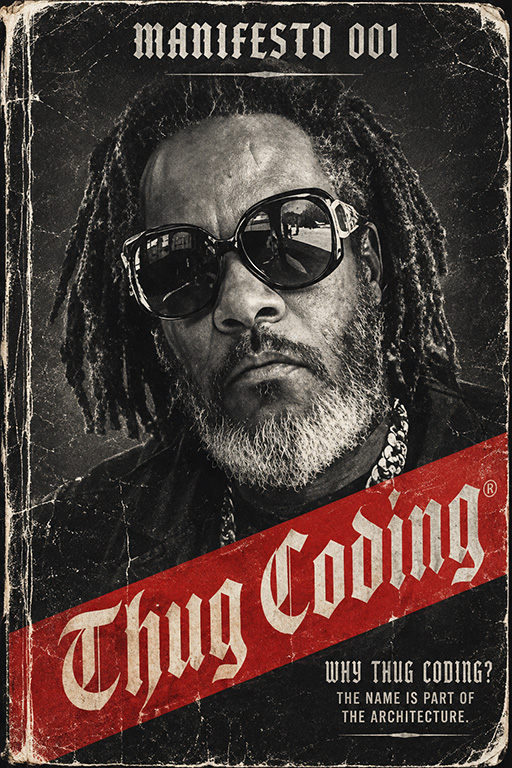
MANIFESTO 001 — WHY THUG CODING®?
The name is part of the architecture.
Why call it THUG CODING®?
I knew that question would come.
It is supposed to.
The name makes some people curious. It makes some people uncomfortable. Some people immediately understand it. Others hear the word thug and think they already know what this is about.
They probably don't.
THUG CODING® is not about glorifying violence, drugs, robbery, cheating, gangs, prison, or any of the other destructive things that have become associated with street life.
I grew up close enough to those things to understand that there is nothing romantic about them.
I have seen extraordinary intelligence pointed in the wrong direction.
I have watched people study things that could get them killed with more dedication than some people study things that could make them free.
That is part of where THUG CODING® comes from.
When I was young, I watched my older brother Anthony practice for hours in our garage in South Central Los Angeles.
Sometimes eight hours a day.
Practicing.
Practicing.
Practicing.
His hands had to be perfect.
He worked with altered dice. Different configurations. Different shapes. Different mathematical advantages. Some were designed to favor certain outcomes. Some were physically altered so dramatically that they almost wanted to land a particular way.
Then there was the human part of the system.
Palming.
Switching.
Timing.
Observation.
Memory.
Confidence.
Knowing when to move.
Knowing when not to move.
I practiced with him sometimes.
And although I was fascinated by what he could do, something else fascinated me just as much.
How did somebody figure all of this out?
I remember sitting in the car while Anthony went into a building to get those dice and trying to imaginize how they were made.
What was the process?
Who designed them?
How did they know what to change?
How did changing the physical object change the probability?
I didn't have the vocabulary for it then.
I didn't know anything about software engineering.
I wasn't thinking about algorithms.
I wasn't thinking about APIs.
I wasn't thinking about artificial intelligence.
I was a kid looking at a small brown paper bag full of dice.
But I was looking at a system.
And decades later, I understand something that I couldn't articulate then:
The technology was already there.
YOU ARE TECHNOLOGY
We have been conditioned to think technology means computers.
Phones.
Robots.
Software.
Artificial intelligence.
Machines.
Those things are technology.
But technology did not begin with the computer.
Technology begins with the human being.
Technology is knowledge applied to solve a problem, create an advantage, extend human capability, or produce a repeatable result.
Look at those dice again.
Somebody understood mathematics.
Somebody understood probability.
Somebody understood materials.
Somebody understood physical dimensions.
Somebody understood human perception.
Then Anthony added technique.
Practice.
Timing.
Dexterity.
Psychology.
The object was part of the technology.
His knowledge was part of the technology.
His hands were part of the technology.
He was part of the technology.
That realization became important to me much later because it changed how I thought about people.
Especially people from places like where I came from.
DON'T CONFUSE ENVIRONMENT WITH CAPACITY
There is intelligence in the hood.
There always has been.
There is creativity in the hood.
There is mathematics in the hood.
There is engineering in the hood.
There is entrepreneurship in the hood.
There are networks.
There are systems.
There is communication.
There is negotiation.
There is risk analysis.
There is pattern recognition.
There is improvisation.
There are people who can study something relentlessly until they understand every moving part of it.
The problem is not always the absence of intelligence.
Sometimes the problem is what that intelligence has been pointed toward.
That distinction matters.
Because capability and application are not the same thing.
A person can possess tremendous discipline and apply it destructively.
A person can understand systems and use that knowledge to exploit people.
A person can understand chemistry and make medicine or poison.
A person can understand computers and build educational software or malware.
A person can understand artificial intelligence and use it to create opportunity or manipulate somebody.
Technology doesn't determine morality.
People do.
That's one of the things Anthony taught me without ever sitting me down to teach it.
I admired his mastery.
I recognized his discipline.
I respected the amount of work required to become that precise.
But I didn't want his destination.
I wanted the capability.
I wanted to know what would happen if that same intensity was pointed somewhere else.
CHANGE THE DESTINATION
I saw people chase money in ways that were violent, destructive and ultimately meaningless.
And I came to a strange conclusion.
I didn't decide that money didn't matter.
I decided that I had to have it too.
But I didn't want to murder somebody for it.
I didn't want to poison people for it.
I didn't want to rob people for it.
I didn't want to cheat people for it.
So I started looking for another way.
I worked.
I learned how to sell.
I learned customer service.
I learned independence.
I experimented with entrepreneurship.
Later, music became another technology for me.
Rhythm.
Language.
Timing.
Memory.
Pattern recognition.
Performance.
Communication.
Creation.
Years of developing those abilities eventually put me in a studio with an opportunity to write a theme song for an NBC television show.
I didn't arrive with some extraordinary machine.
I arrived with a 99-cent notebook and an ink pen.
I heard the music.
I wrote.
About thirty minutes later, something existed that had not existed before.
That creation became intellectual property.
And that intellectual property continued producing economic value.
Think about that progression.
Brown paper bag.
99-cent notebook.
Intellectual property.
Computer.
Different tools.
Same human machine.
SO WHY THUG CODING?
Because I refuse to believe that somebody has to stop being who they are before they are allowed to participate in technology.
You don't have to change the way you talk first.
You don't have to pretend you grew up somewhere else.
You don't have to erase your neighborhood.
You don't have to become culturally acceptable to Silicon Valley.
You don't have to put on somebody else's uniform before you are allowed to understand a computer.
And you certainly don't have to wait for somebody to come into your neighborhood and give you technology.
You are already technology.
The computer is a tool.
Code is a tool.
The internet is a tool.
AI is a tool.
And tools amplify the person using them.
THUG CODING® exists because I want people who may never have imagined themselves as programmers, engineers, developers, founders, researchers, designers, inventors or technologists to understand something:
You belong here too.
Not because somebody lowered the requirements.
Not because somebody created a diversity program.
Not because somebody felt sorry for you.
Because the fundamental abilities required to build things have been inside human beings all along.
Observation.
Curiosity.
Memory.
Imagination.
Practice.
Pattern recognition.
Communication.
Persistence.
Problem solving.
Creativity.
Discipline.
Those things don't belong to Silicon Valley.
They belong to you.
THE NAME IS PART OF THE ARCHITECTURE
So why not give this project a safer name?
Why not call it something polished?
Something corporate?
Something that wouldn't require an explanation?
Because then we would lose part of the point.
THUG CODING® is supposed to create a collision.
Two words that some people don't expect to see together.
THUG.
CODING.
One word carries cultural assumptions about who somebody is.
The other carries cultural assumptions about who somebody is capable of becoming.
Put them together and something interesting happens.
The assumptions begin to break.
A person you stereotyped as a consumer becomes a creator.
A person you imagined only as an entertainer becomes an engineer.
A hustler studies APIs.
A rapper builds software.
A kid who understands the systems operating on his block begins understanding the systems operating inside a computer.
Someone who spent eight hours practicing something that could destroy his future spends eight hours learning something that could build it.
The capability was already there.
We changed the application.
We changed the tools.
We changed the destination.
WE ARE NOT TRYING TO RECREATE SILICON VALLEY IN THE HOOD
That isn't the mission.
I don't want South Central to become Silicon Valley.
I want kids in South Central to understand that they can build technology from South Central.
I want technology education to exist without requiring cultural surrender.
I want somebody to be able to walk into the lab exactly as they are and leave knowing more than they knew when they entered.
Then come back tomorrow.
Practice.
Practice.
Practice.
Because that part of Anthony's lesson was absolutely correct.
Mastery requires work.
There is no slogan that replaces it.
There is no AI that eliminates it.
There is no shortcut around understanding your craft.
If you want to become great at something, eventually you have to sit in your version of that garage.
And work.
The difference is what we're practicing.
FROM CONSUMERS TO BUILDERS
Too many communities experience technology primarily as consumers.
We buy the phones.
Use the apps.
Create the content.
Feed the algorithms.
Generate the data.
Pay the subscriptions.
Watch the advertisements.
Then somewhere else, somebody owns the infrastructure.
I want to change that relationship.
I want us building the software.
Understanding the APIs.
Running the servers.
Training the models.
Designing the interfaces.
Owning the intellectual property.
Starting the companies.
Teaching the next person.
Creating technology that solves problems in our own communities and problems far beyond them.
Not everybody has to become a programmer.
That's not the point.
The point is understanding that these systems are not magic.
Somebody built them.
And you can learn how they work.
You can take them apart conceptually.
You can understand the pieces.
You can modify them.
You can connect them.
And eventually—
you can build your own.
THAT IS THUG CODING®
THUG CODING® is not an attempt to romanticize the street.
It is an attempt to recognize the human capability that can exist there and refuse to throw that capability away.
Take the curiosity.
Take the creativity.
Take the resilience.
Take the improvisation.
Take the entrepreneurship.
Take the ability to recognize patterns.
Take the willingness to practice.
Take the ability to survive inside complicated systems.
Then introduce better tools.
Knowledge.
Computers.
Programming.
Engineering.
AI.
Business.
Ownership.
And purpose.
Don't confuse where intelligence was developed with what that intelligence is capable of building.
That kid standing on the corner isn't standing outside of technology.
That single mother figuring out how to make insufficient resources cover impossible expenses isn't standing outside of technology.
That musician constructing something from rhythm and language isn't standing outside of technology.
That entrepreneur trying idea after idea isn't standing outside of technology.
The human being is the original machine.
Everything else is leverage.
So when somebody asks me:
Why THUG CODING®?
My answer is simple.
Because I have already seen what extraordinary human capability can do when it is pointed in the wrong direction.
I want to see what happens when we point it toward the future.